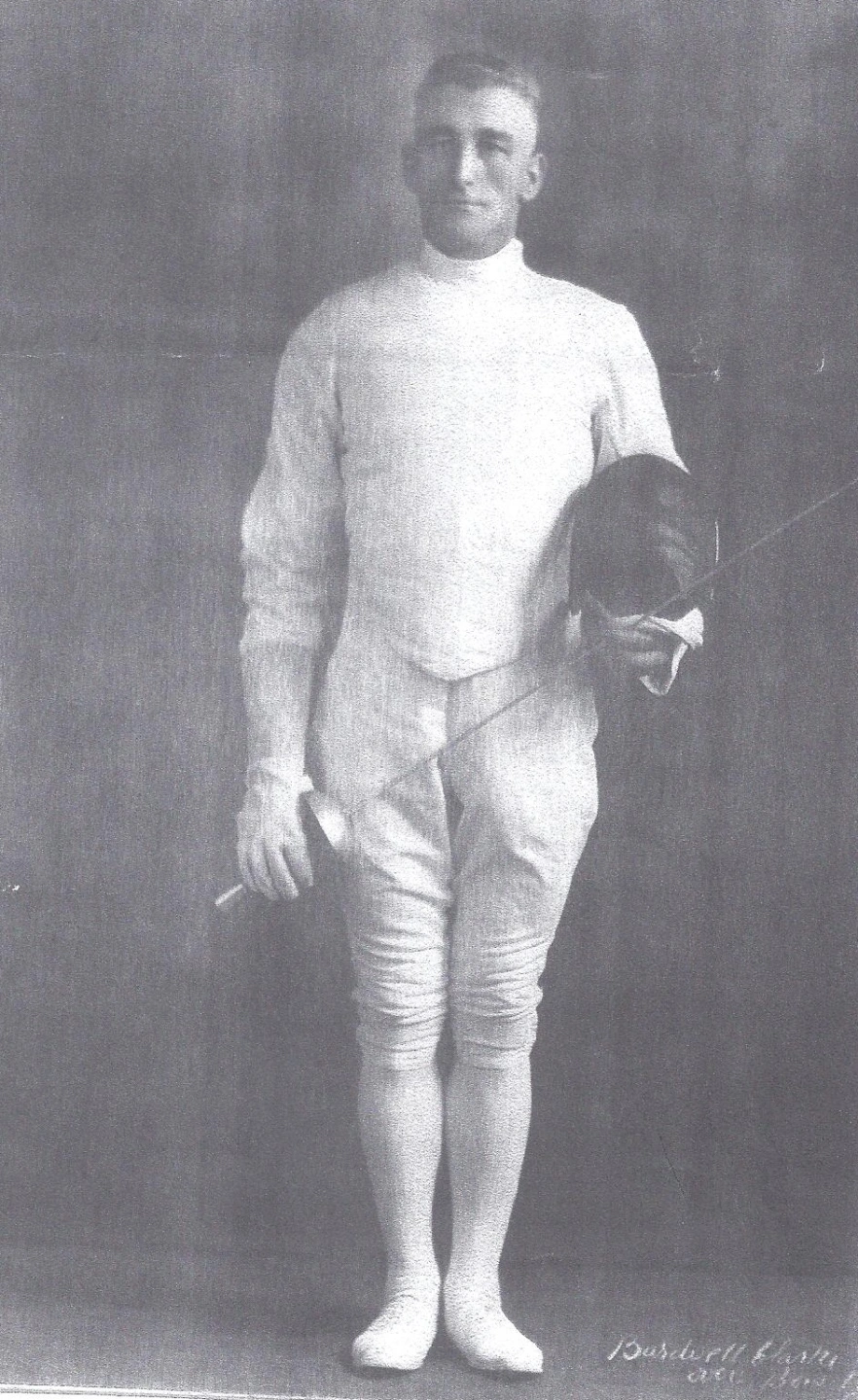
Major Arthur George Saunders 1884 to 1946
Research for this book established that Major Arthur Saunders was heavily involved in the early teaching of fencing in Perth for some years, but regrettably the passage of time has left us with little detail locally [in particular dates] of his involvement.
However, I have been able to obtain some information from his daughter, Mrs Sheilagh Couper, who now lives in the UK, and I have therefore included this in the book, although authentication has not been possible.
Arthur George Saunders was born in Dublin, Ireland, in 1884, of Irish parentage.
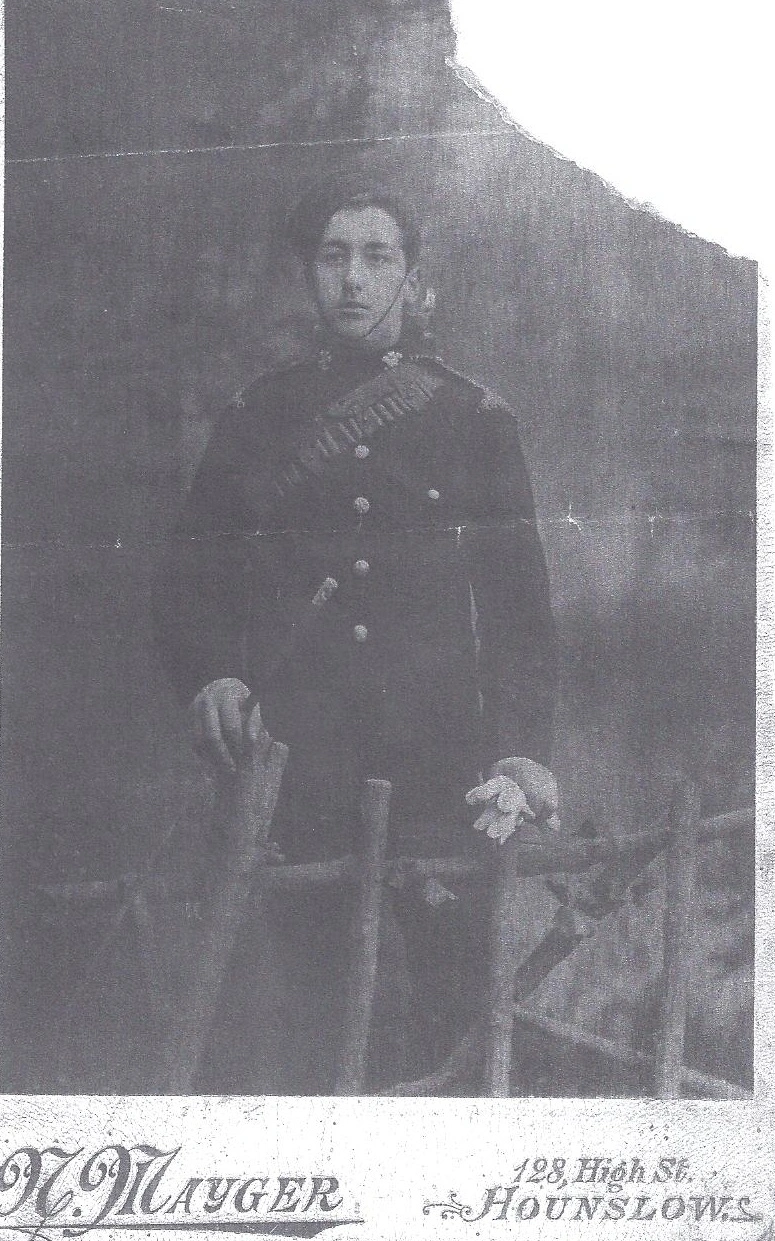
He attended the Bluecoat School but before he finished his schooling, he ran away and joined the British Army. His Regiment was the 10th [the Prince of Wales Own] Royal Regiment of Hussars, who were known as “the Cherry Pickers” because of the colour of the Pelisse that formed part of their uniform [a Pelisse is a short cape or cloak that was generally worn over one shoulder as part of their uniform].
His mother, who was very distressed at his choice of career, tried to “buy him out” [which was possible in those days], but was persuaded by influential friends in the Army to leave him there “as it would make a man of him”.
He achieved the rank of Corporal after some eight years of service during which he must have shown great promise and was fortunate to receive wonderful training in many branches of physical education which included musketry, boxing, gymnastics, swimming and other sports including Fencing. Here he was most fortunate, as his fencing tutor had been a pupil of Leon Bertrand, the great French fencer, teacher and author of books on Fencing.
He left the British Army in 1908 and came to Western Australia, where his uncle, Doctor White, was a very well - known personage who had his practice in Fremantle. [Doctor White was also attached to the Commonwealth Military Force and went to Gallipoli in command of the Western Australian Medical Corps].
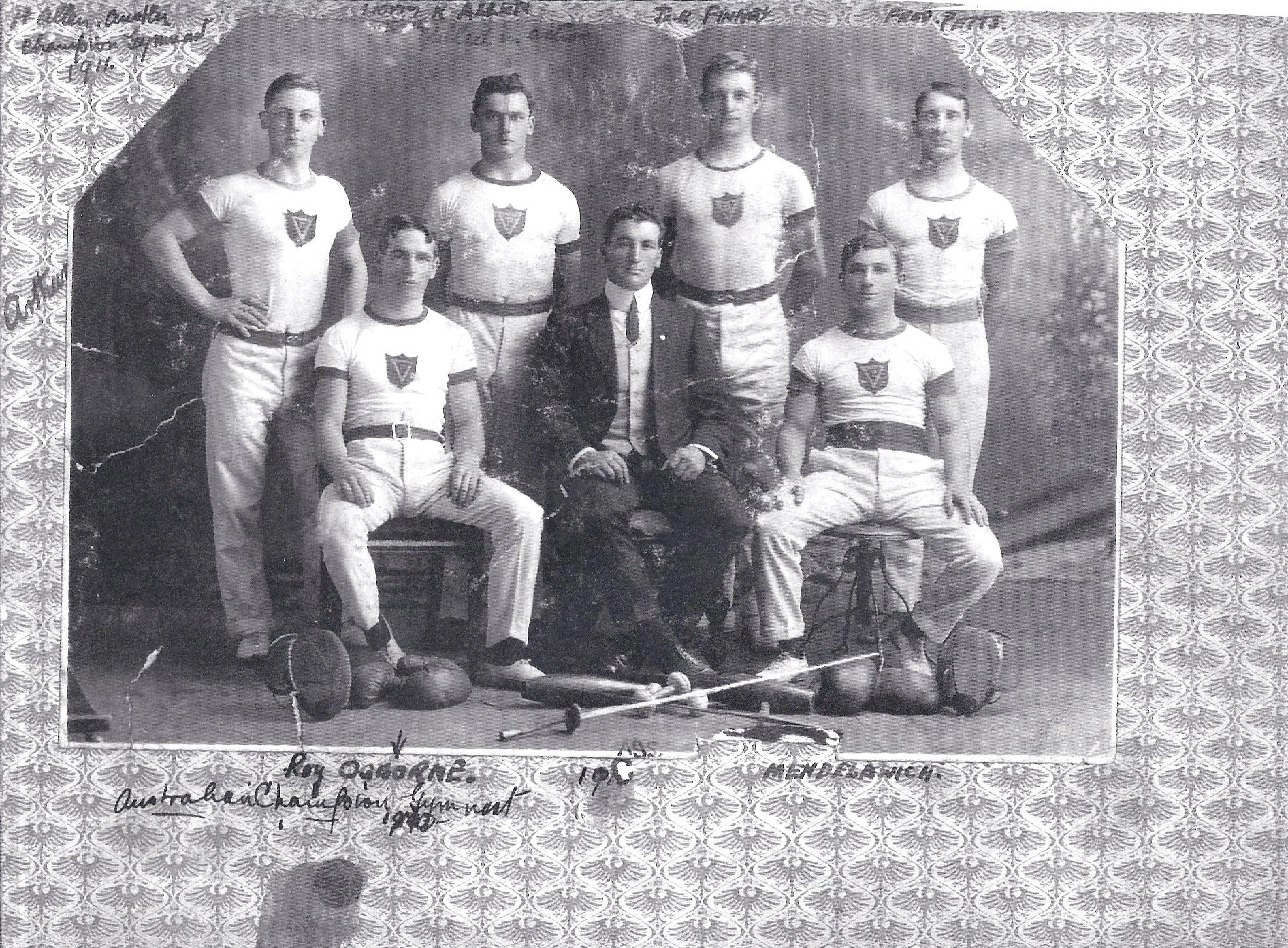
Saunders accepted the post of Physical Director to the YMCA in 1911, and on his curriculum vitae it says, “He is a competent instructor in all branches of physical training and teaches according to the most modern methods employed on the Continent, boxing, fencing, swimming and life - saving etc. with very successful results. He was an expert rider and good shot, holds the award of merit from the Royal Life Saving Society’.
He joined the Commonwealth Military Forces, as a Lieutenant in 1912 and in 1913 was an Instructor in the Light Horse.
On the outbreak of War in 1914, he asked to be released to go overseas, but this request was refused so, despite the fact that he might be cashiered he jumped ship at Fremantle. He worked his passage to England on the “S S Omrah” [the Orient Steam Navigation Company] as an Able Seaman.
On arrival, he was somehow able to join the British Army as a Lieutenant in the Royal Middlesex Regiment, and then transferred to the Royal Engineers. He used to boast that he was the only Officer in the Regiment who was not an Engineer, but apparently their need at the time was for an Officer with his obvious ability to control men in the field.
In 1915, he married an Irish girl from Dublin named Rose Florence Clarence [nicknamed “Flo”] and that same year went to the horrors of the War in France. He was not satisfied with what went on through the battle of the Somme, where he was buried to his neck in a shell hole. In 1917, he volunteered to go to Russia to fight against the Communists, where he was gassed and invalided out of the Army as “unfit for further service”
He spent some time trying unsuccessfully to persuade the Army that he was fit for service and refused to take a full army pension. He achieved the substantive rank of Major and Acting Lieutenant Colonel.
During this time he obviously served with courage and distinction as he was twice recommended for the Military Cross, Mentioned in Despatches and awarded the Russian Order of St. Anne [2nd Class] -see addendum.
During these years a son, Jack, was born to Arthur and Rose.
In 1920, Major Saunders decided to return to Western Australia with his family, his mother and one of his sisters, Margaret.
Margaret was a well - known landscape painter and portrait artist who also taught at several private schools for many years before and after the Second World War. She never married.
It is not certain in what year, but Major Saunders opened the Western Australian Academy of Fencing and Physical Education in a large room at the top of a building at 811 Hay Street, Perth. He also taught these skills at several schools and taught physical culture and unarmed combat to the 10th Light Horse Regiment. He was also qualified in, and taught, first aid.
In 1923 a daughter, Sheilagh was born to Arthur and Rose and she can remember as a child frequently going to the Academy where, as soon as she was old enough, her father taught her to fence.
In 1936 or 1937, the Academy moved to London House, which was in Murray Street, near King Street, Perth.
Major Saunders had his most proud moment when he was invited to act as a judge at the Olympic Games between the two World Wars, but as all officials then had to pay their own fares and all expenses, he could not afford to go.
Although he had by now regained all of his physical strength, he sadly had to close the Academy in 1939 due to the depressed state of the economy at that time.
In the years between 1920 and 1939, in addition to his fencing activities, Major Saunders also became a visiting teacher to a large number of schools and accepted the responsibility for arranging enormous displays similar [although on a smaller scale] to those now performed at such events as the Commonwealth Games.
He also captained many hockey teams in Perth, even including a visiting English team against a Western Australian team.
The Royal Life Saving Society was another of his interests and during the summer he was a judge at the Carnivals held at Cottesloe, Scarborough and City Beach. This Society awarded him a medal for outstanding service, which he treasured.
With the outbreak of World War II in 1939, Major Saunders volunteered to fight again. When told that, at 55 he was too old, he went to work making ammunition in a converted factory.
He also, in company with his daughter, Sheilagh, joined a group, which did concert parties at various military camps, when they performed exhibition fencing bouts. Part of the performance would be some trick - one of these was for Major Saunders to suspend a broom handle on two sabres, then break the broom handle in half with a third sabre. This was done without breaking the tissue paper ring on which it was suspended.
They had a great time during those days, which ended when son Jack was killed on active service in the Middle East whilst serving as aircrew in the RAAF. Sheilagh’s fiancé, Captain Colin Taggart, was killed at Alamein.
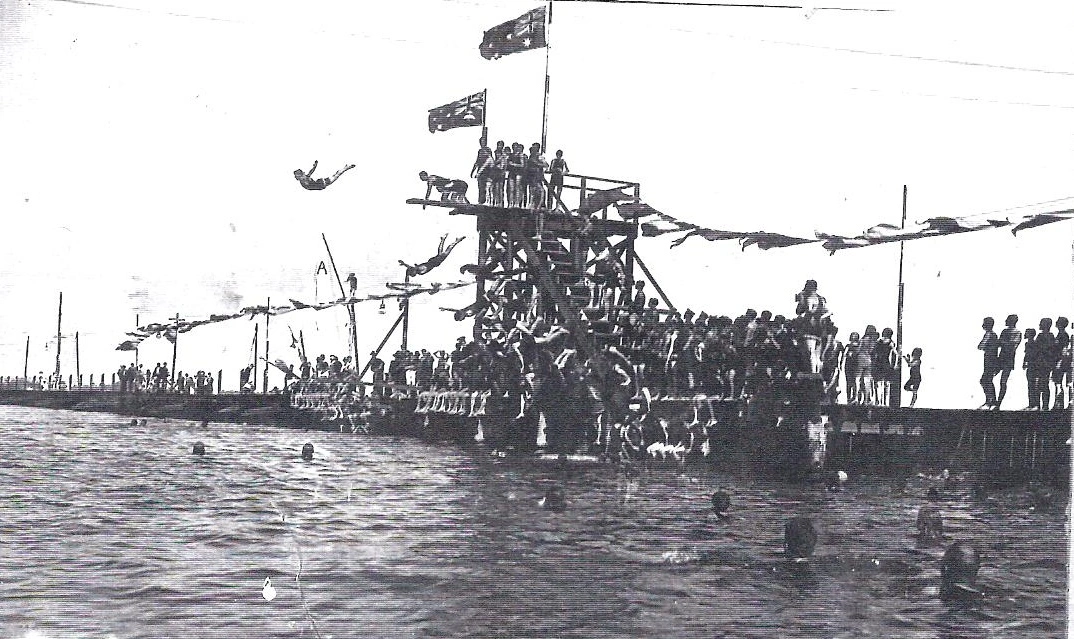
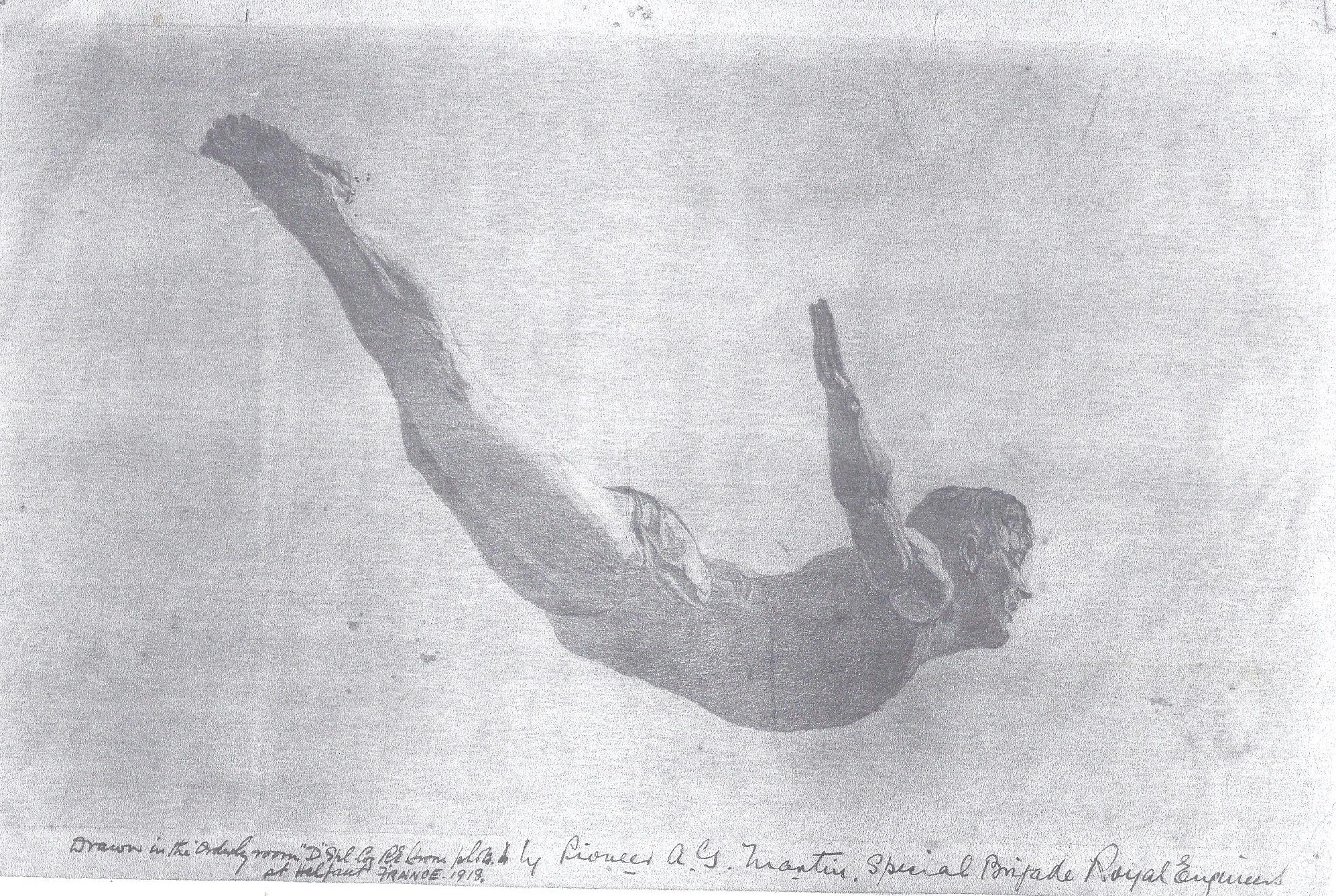
Major Saunders was a magnificent diver and used to head a procession of swimmers and divers each year at the then Crawley Baths in Mounts Bay Road, Crawley, by doing a swallow dive from the 10-metre platform. He was considered WA champion amateur diver for a number of years, and took part in a display at the grand opening of the Crawley Baths on 7th February 1914.
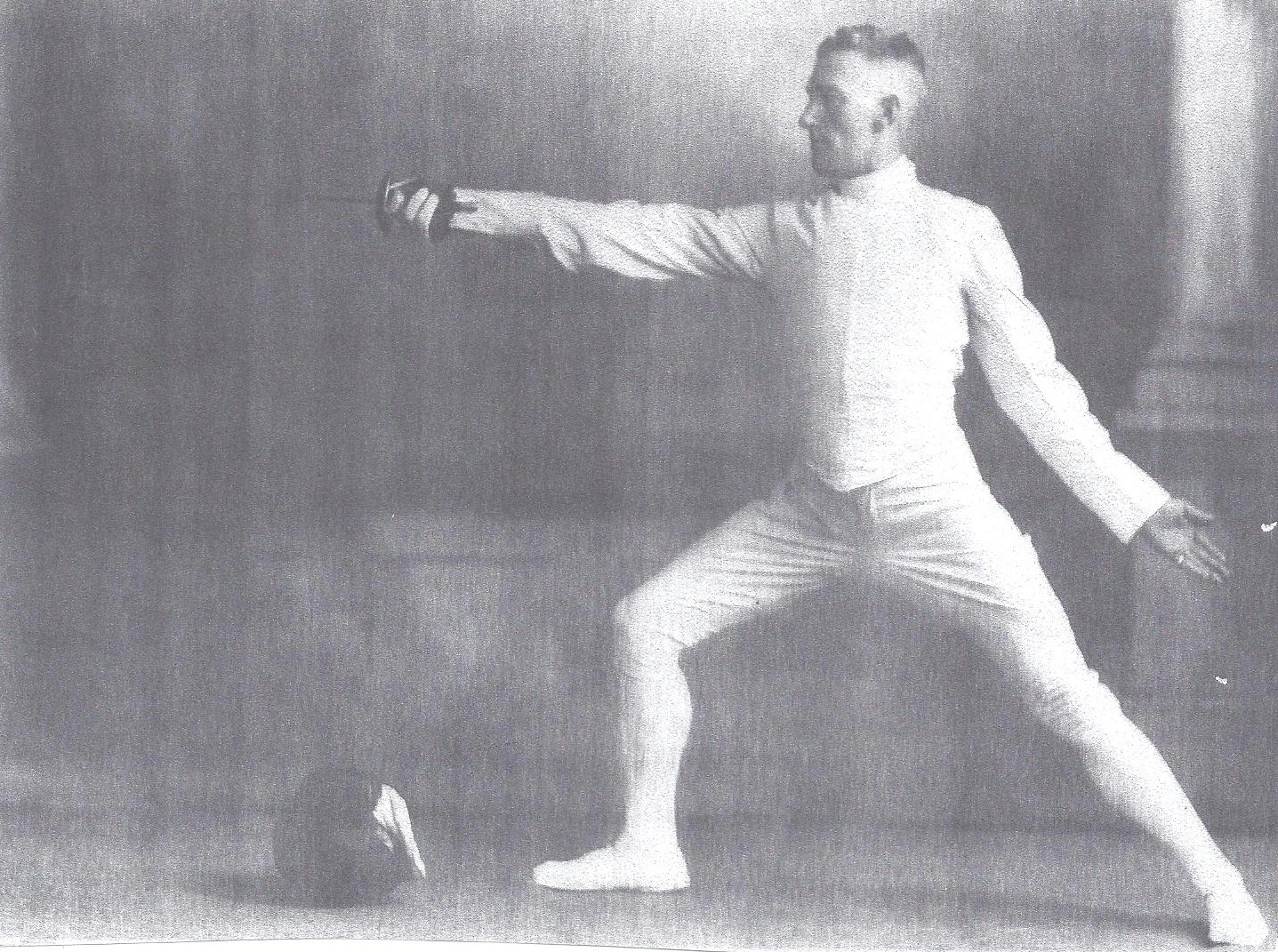
He was the most graceful fencer of the time and an incomparable teacher who was also recognised as WA amateur fencing champion, although the actual years have not been recorded.
During the Second World War he was exhibiting some sign of lung cancer and had a desk job of issuing petrol ration coupons to those entitled to them [petrol was just one of the commodities that had to be rationed during the war].
Major Saunders died in 1946, from lung cancer due to having been gassed during the First World War, and no doubt contributed to by his chain smoking.
After her father’s death, Sheilagh married Mr Alan Mason and they, with her mother [Mrs Saunders] decided to return to England. Sheilagh joined a fencing club and in 1949 became Junior Champion of Ireland, but was prevented from representing Ireland against Scotland because she had not lived in Ireland long enough to qualify residentially.
After a while, Sheilagh ceased fencing as she found that the modern methods of fencing were not the style which had been taught by her father, and said “it had become cut and thrust without the grace and delicacy which Arthur George Saunders had so dearly loved”.
Perhaps a fitting epitaph for a man who always strove for the goal of improved physical fitness.
ADDENDUM
Copy of Officers record of service
Army Book 439
Recommended for Military Cross 23rd September 1916 (Battle of Guille – monte France)
(Signed) E. Slade
Capt Special Coy R. E.
Appointed 2nd in Command D Special Coy R. E. after Bullecourt operation, April 1917
(Signed) L. Casson
Capt O C G Special Coy R. E.
Recommended for Military Cross North Russia September 1919
Awarded Order of Saint Anne 2nd Class, Russia, October 1919
Mentioned in Despatches 3rd February 1920
Major Saunders has served in North Russia both on Archangel Front and at Murmansk. He has been in charge of a Detachment of Special Coys R. E. He has proved energetic, keen and capable at all times. I found him thoroughly reliable.
(Signed) J. H. Davis, Major R. E.
O C Special Coy R. E. North Russia
Saunders Gallery